

I stumbled on Cortical Labs research page after seeing a headline about brain cells playing Doom. My first reaction was the same as everyone else: okay, that sounds like a meme. Then I read the papers. It is weird. It is also serious science.
Melbourne-based Cortical Labs is trying to build computers from living neurons grown on silicon chips. Not a metaphor. Real cells. Real electrical pulses. Real learning, in a dish, while a digital game runs on the other side of the interface.
Their homepage calls this "Artificial Actual Intelligence." Cheesy label. Interesting point: silicon AI tries to imitate what biology already does. Cortical Labs starts with the biology.
The One-Minute Version
Here is the whole idea in one pass:
- Grow neurons on a multielectrode array (MEA).
- Convert game or task state into electrical stimulation patterns.
- Read neural spikes back out.
- Decode spikes into actions (move, shoot, paddle up, and so on).
- Send feedback so the network can adapt over time.
That closed loop is the heart of the work. Without it, you are just poking cells. With it, the culture is embodied in a task. That language comes straight from their landmark 2022 Neuron paper on DishBrain (Kagan et al., 2022).
From Pong to Doom: Why Games Keep Showing Up
In 2021 the team showed neurons learning Pong in a simulated environment. The 2022 paper formalized the setup and reported learning signatures within about five minutes of closed-loop play, which is wild when you remember these are cells in a petri dish, not a trained RL agent burning GPU hours (Kagan et al., 2022).
Internet being internet, people asked the only reasonable follow-up question: can it run Doom?
In 2026 Cortical Labs demonstrated Doom running through the CL1 platform, built with collaborator Sean Cole using their API and Cortical Cloud. Reports describe on the order of 200,000 living human neurons on the chip for that demo, with stimulation patterns encoding game state and spike patterns driving movement and firing. Is it esports-ready? No. Is it a useful stress test for adaptive biological control? Yes.
The game is not the product. The game is a benchmark you can score.
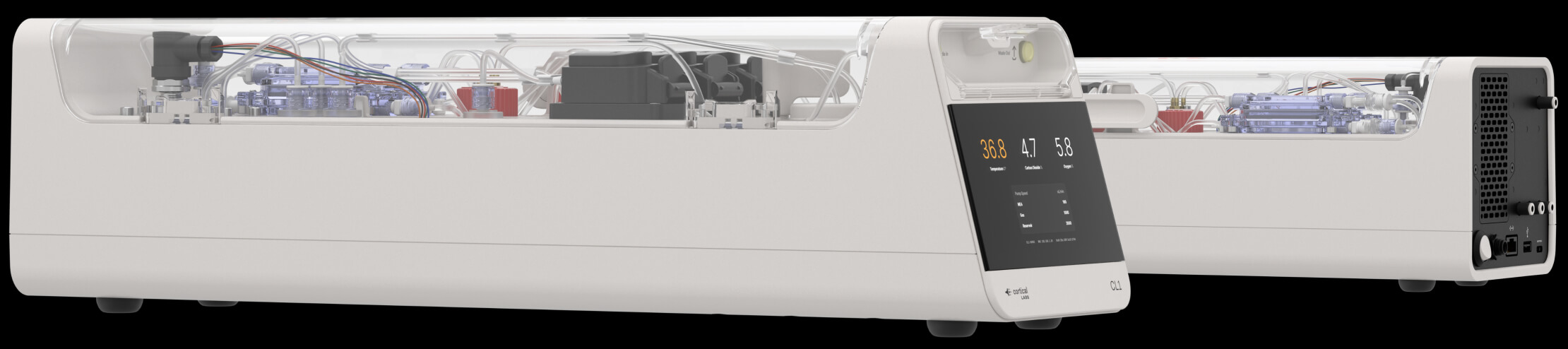
What the CL1 Actually Is
The CL1 is what Cortical Labs calls the world's first code-deployable biological computer. Shipments were announced for researchers who want programmable access to living neural networks without building an entire wet lab stack from scratch.
Important pieces:
- Hardware: neurons cultured on a custom high-density MEA inside a life-support system (Cortical Labs cites up to ~6 months viability).
- biOS: their Biological Intelligence Operating System, which creates the simulated world the neurons interact with.
- Closed-loop I/O: bi-directional stimulation and recording in real time.
- Programmability: Python-accessible APIs so developers can treat the culture like a compute substrate, not a one-off experiment.
- Cortical Cloud: remote access and scaling without every lab owning full infrastructure.
The Science Behind the Headlines: Free Energy and Feedback
The DishBrain work did not use conventional reward labels like a reinforcement learning pipeline with explicit score tensors. It drew on active inference and the free energy principle (Friston, 2010; Kagan et al., 2022).
Plain English version: the system nudges neural cultures toward predictable sensory outcomes when they do something useful, and away from chaotic stimulation when they do not. Over time, activity reorganizes. Synapses shift. The culture behaves less randomly relative to the task.
That is why closed-loop structure matters so much. If the world never reacts to spikes, there is nothing to learn from.
Organoid Intelligence and the Bigger Picture
Cortical Labs sits inside a wider movement sometimes called organoid intelligence (OI) or synthetic biological intelligence (SBI).
The 2023 Frontiers in Science paper "Organoid intelligence (OI): the new frontier in biocomputing and intelligence-in-a-dish" outlines a roadmap for brain organoids as biological hardware, with richer 3D cultures, perfusion, MEAs, machine learning interfaces, and embedded ethics (Smirnova et al., 2023). Brett Kagan from Cortical Labs is among the authors, which tells you how connected these threads are.

CL1 today uses neural cultures on MEAs. OI tomorrow may push toward larger, more structured organoids with richer input/output. Same direction: biology as compute.
Walking Through the Research Library
The official research list is not one paper. It is a whole field guide. I grouped the published work the way I wish someone had grouped it for me.
Platform and tooling
- CL API: Real-Time Closed-Loop Interactions with Biological Neural Networks - the software bridge developers actually use.
- The CL1 as a platform technology to leverage biological neural system functions - why the hardware matters as infrastructure, not a one-off demo.
Learning in a game-world
- In vitro neurons learn and exhibit sentience when embodied in a simulated game-world - the DishBrain / Pong paper in Neuron (Kagan et al., 2022).
- Biological Neurons Compete with Deep Reinforcement Learning in Sample Efficiency in a Simulated Gameworld - sample efficiency comparison that gets cited a lot.
- Dynamic Network Plasticity and Sample Efficiency in Biological Neural Cultures - follow-on comparative work with DRL.
- Critical dynamics arise during structured information presentation within embodied in vitro neuronal networks - what happens inside the network when information arrives in structured bursts.
Synthetic biological intelligence as a field
- A Computational Perspective on NeuroAI and Synthetic Biological Intelligence
- Why AI Progress Will Necessitate Harnessing Synthetic Biology to Leverage the Ground Truth of Intelligence
- Two roads diverged: Pathways toward harnessing intelligence in neural cell cultures
- The technology, opportunities, and challenges of Synthetic Biological Intelligence
- Harnessing Intelligence from Brain Cells In Vitro
Organoids, ethics, and definitions
- Organoid intelligence (OI): the new frontier in biocomputing and intelligence-in-a-dish (Smirnova et al., 2023)
- Intersection between the biological and digital: synthetic biological intelligence and organoid intelligence
- Human Neural Organoid Microphysiological Systems Show the Building Blocks Necessary for Basic Learning and Memory
- Neurons Embodied in a Virtual World: Evidence for Organoid Ethics?
- Embodied Neural Systems Can Enable Iterative Investigations of Morally Relevant States
- A Quantifiable Information-Processing Hierarchy Provides a Necessary Condition for Detecting Agency
- Toward a nomenclature consensus for diverse intelligent systems: Call for collaboration
Methods and applications
- A novel protocol for the efficient generation of all three major hippocampal neuronal sub-populations from human pluripotent stem cells - cell sourcing matters for reproducible cultures.
- Drug treatment alters performance in a neural microphysiological system of information processing - one of the most practical near-term use cases: pharmacology on human-relevant neural hardware.
- Active Inference and Intentional Behavior - theory tie-in for the feedback paradigm.
- Starting a synthetic biological intelligence lab from scratch - practical guide for teams entering the space.
Key Papers Worth Reading First
| Paper | Year | Why it matters |
|---|---|---|
| In vitro neurons learn and exhibit sentience when embodied in a simulated game-world | 2022 | Foundational DishBrain paper. Defines synthetic biological intelligence and closed-loop embodiment. |
| Organoid intelligence (OI): the new frontier in biocomputing and intelligence-in-a-dish | 2023 | Field roadmap for organoid-based biocomputing; connects to Cortical Labs via Kagan. |
| Biological Neurons Compete with Deep Reinforcement Learning in Sample Efficiency | 2023 | Direct comparison that makes the "biology learns fast" claim concrete. |
| The CL1 as a platform technology | 2024+ | Moves the story from experiment to productized research hardware. |
| Drug treatment alters performance in a neural microphysiological system | 2023 | Shows pharma-adjacent value beyond gaming demos. |
Real Use Cases (Not Just Doom Memes)
Cortical Labs markets the CL1 for drug discovery, disease modeling, and understanding learning itself. That is more believable than "replace your laptop with a petri dish."
- Neuropharmacology: test compounds on living human-relevant neural tissue and watch information processing change.
- Disease models: compare healthy versus patient-derived neural cultures under identical closed-loop tasks.
- Fundamental neuroscience: study plasticity with precise stimulation and readout at scale.
- Hybrid AI research: pair biological networks with conventional ML encoders/decoders, as in the Doom work with PPO-style training on the digital side.
- Reduced animal testing: Cortical Labs explicitly positions human cell-based systems as an ethically relevant alternative for certain experiments.
Ethics: The Part You Cannot Hand-Wave Away
Once neurons are trained in game-worlds and discussed using words like "sentience" and "agency," ethics stops being optional. Cortical Labs publishes on this directly, including work on organoid ethics, morally relevant states, and nomenclature for diverse intelligent systems.
The honest position: we do not fully know what these cultures experience, if anything. But the research community is already asking the right questions before the hardware gets cheap and widespread. That is better than the alternative.
How This Differs from Normal AI
| Topic | Silicon AI | Cortical Labs / SBI |
|---|---|---|
| Hardware | GPUs, TPUs, fixed weights in memory | Living neurons on MEAs, physically rewiring over time |
| Learning | Backprop, huge datasets, offline training | Activity-dependent plasticity during closed-loop tasks |
| Energy | Large for big models | Biological systems can be far more efficient for some learning tasks |
| Programmability | Exact, deterministic code paths | Hybrid: digital encoder/decoder plus living substrate you steer, not fully control |
What I Take Away
Cortical Labs is not claiming they shipped consciousness in a box. They shipped an interface to living neural computation that you can program. That alone is a category shift.
The research page is worth bookmarking because it spans the full stack: theory (active inference), experiments (Pong, Doom, drug response), platform engineering (CL1, CL API, Cortical Cloud), and ethics. Most labs pick one lane. Cortical Labs is trying to own the whole bridge between wetware and software.
If you are new here, start with the 2022 Neuron DishBrain paper, skim the OI roadmap paper from 2023, then watch the Doom demo with the understanding that the game is a test harness, not the end goal. After that, the rest of the library on corticallabs.com/research reads in order instead of like sci-fi fragments.
Still think biological computing is just a headline? Fair. Read the Neuron paper anyway. The methods section is where the hype goes to get audited.
Bibliography
- Cortical Labs. (2026). Research. https://corticallabs.com/research
- Cortical Labs. (2026). CL1: The world's first code deployable biological computer. https://corticallabs.com/cl1
- Kagan, B. J., Kitchen, A. C., Tran, N. T., Habibollahi, F., Khajehnejad, M., Parker, B. J., Bhat, A., Rollo, B., Razi, A., & Friston, K. J. (2022). In vitro neurons learn and exhibit sentience when embodied in a simulated game-world. Neuron, 110(23), 3952-3969.e8. https://doi.org/10.1016/j.neuron.2022.09.001
- Smirnova, L., Caffo, B. S., Gracias, D. H., Huang, Q., Morales Pantoja, I. E., Tang, B., Zack, D. J., Berlinicke, C. A., Boyd, J. L., Harris, T. D., Johnson, E. C., Kagan, B. J., Kahn, J., Muotri, A. R., Paulhamus, B. L., Schwamborn, J. C., Plotkin, J., Szalay, A. S., Vogelstein, J. T., Worley, P. F., & Hartung, T. (2023). Organoid intelligence (OI): the new frontier in biocomputing and intelligence-in-a-dish. Frontiers in Science, 1, 1017235. https://doi.org/10.3389/fsci.2023.1017235
- Friston, K. (2010). The free-energy principle: a unified brain theory? Nature Reviews Neuroscience, 11(2), 127-138. https://doi.org/10.1038/nrn2787
- Tom's Hardware. (2026). 200,000 living human neurons on a microchip demonstrated playing Doom. https://www.tomshardware.com/tech-industry/artificial-intelligence/200-000-living-human-neurons-on-a-microchip-demonstrated-playing-doom-cortical-labs-cl1-video-shows-the-gameplay-and-explains-how-the-neurons-learn-the-game